
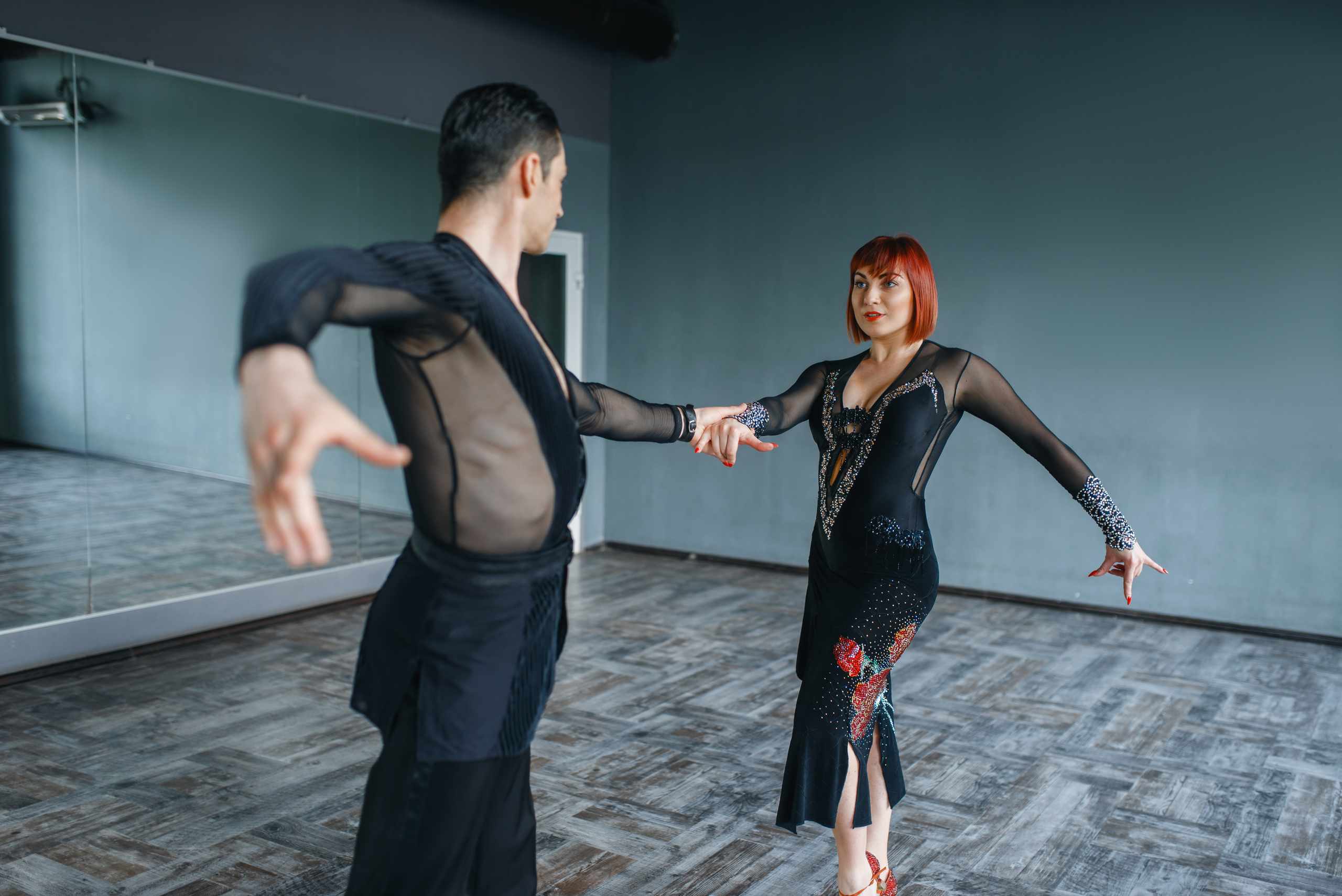
How to Transfer Weight Cleanly Between Ballroom Steps
If a dancer is feeling off balance while working on his footwork in a dance, it’s very likely his or her weight isn’t properly settled on the leg that the dancer is supposed to be standing on. A dancer should feel as if the dancer’s weight has completely shifted over onto one leg before the next step. If the dancer lifts his or her free foot, there shouldn’t be any wobble or need for body adjustment to compensate for the movement. A dancer who is standing balanced on one leg should be able to move that free foot in any direction without making any adjustments in body movement in the same way a person standing on one leg can move the free foot however he wishes with no adjustments. If a dancer has a difficult time lifting the foot or feels unbalanced, the dancer’s weight hasn’t actually moved to the other leg and the dancer’s center is still right between the feet. The dancer moved the feet into the proper position but didn’t get the body to match.
The fix is usually to make sure that a dancer keeps the posture and doesn’t lean over towards the next step before the dancer gets to the actual step. The dancer will also need to listen to the counting (or count aloud) and make sure that there’s something specific the dancer can feel happening on each count. If the dancer has a habit of rushing steps or taking very large strides, the dancer will get to the next beat in the music before he or she feels the weight fully transferred onto the previous step. This would be a good time to slow down a bit to make sure that the steps are at a manageable size that can be comfortably controlled.
The size of the steps will often go hand-in-hand with the tempo. It’s hard to get the proper balance if the dancer is moving forward or backwards too quickly, so the dancer will end up with legs spread too far apart without getting the dancer’s center from one foot to the other. This leaves the dancer feeling off balance and uncertain where the next step should even go.
Weight transfer also comes into play when a dancer is partnered. The weight transfer should be completely finished and balanced before the start of the next step as the same rules of body control apply. If there is any hesitance or uncertainty about the next move, it will be transferred to the partner in the form of a push, pull or hesitation in the frame. The partner may read from the dancer’s body that they are going in a direction the dancer isn’t intending them to go or get a reaction from the dancer that’s not the correct reaction for the current dance move. This means the frame will be out of balance between the two dancers.
This is why both dancers need to be balanced and comfortable with their moves in a partner dance. The leads or follows aren’t necessarily being given incorrectly but can’t properly be read without the balance and proper weight transfer of the dance partner.
Once a dancer has the basics down, a partner will be extremely helpful in practicing proper weight transfer in dancing. If one dancer feels unbalanced, he or she will most likely feel some tension in his or her arms while trying to maintain balance. That tension would be a sign that the frame is being used to help the dancers balance instead of them being on their own balance.